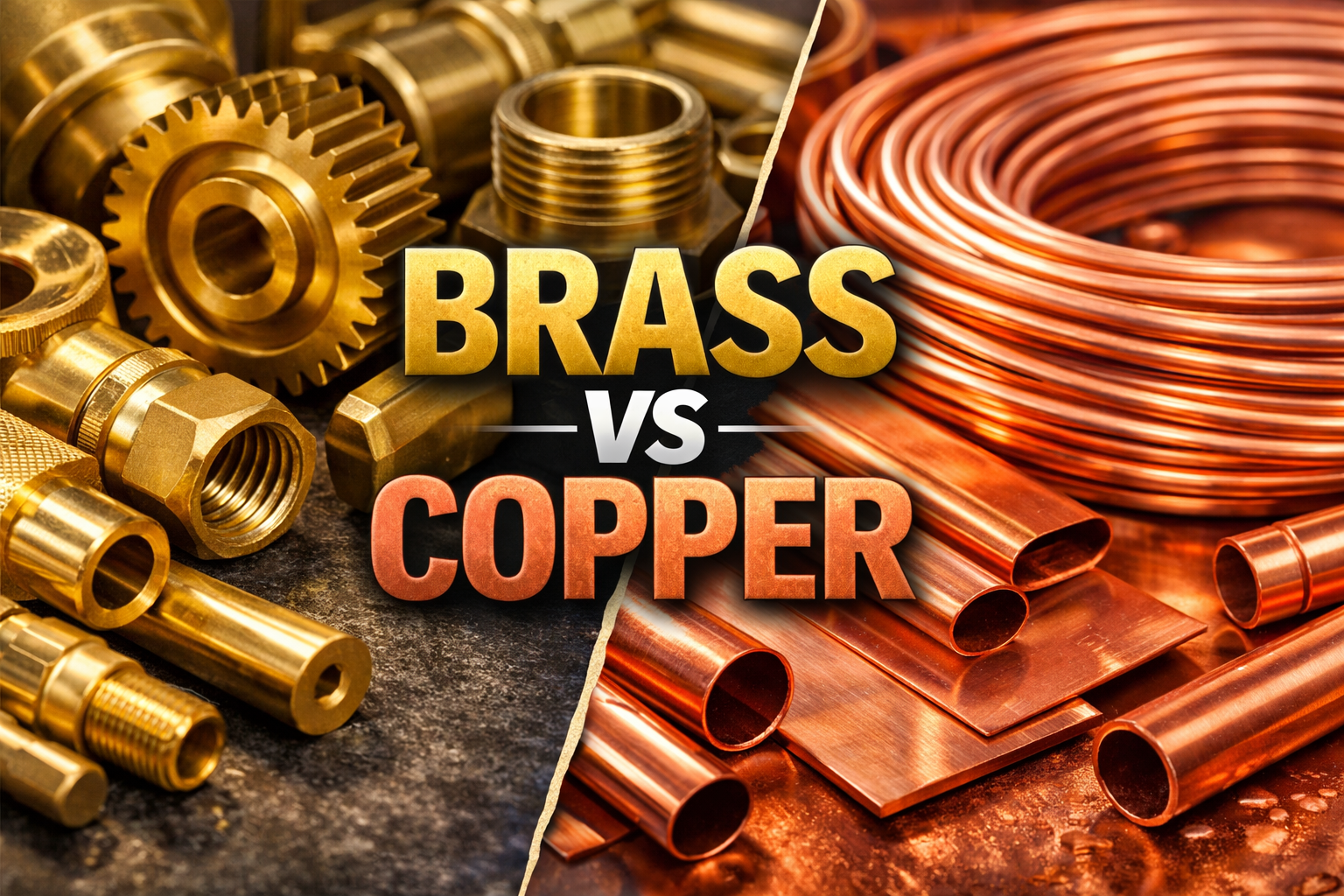
Brass vs Copper – Key Differences in Properties & Uses of Brass and Copper
Introduction
Brass and copper are closely related metals widely used in engineering, manufacturing, and electrical systems. Both offer strong corrosion resistance and good workability, but they differ significantly in strength, conductivity, machinability, and cost. Understanding the brass vs copper comparison helps engineers select the right material for mechanical, electrical, and industrial applications.
Brass vs Copper Key Takeaways
- Copper is a pure metal, while brass is an alloy of copper and zinc.
- Copper has significantly higher electrical and thermal conductivity than brass.
- Brass is stronger, harder, and easier to machine than pure copper.
- Copper usually costs more, while brass is often selected for cost-effective mechanical parts.
Key Differences Between Brass and Copper Properties
Material selection in engineering often starts with a clear comparison of physical and mechanical properties. While copper and brass share similar corrosion resistance and workability, their composition changes their performance in practical applications.
Physical Properties of Brass and Copper
Copper is a naturally occurring metal with high purity in most industrial grades. Brass, on the other hand, is created by alloying copper with zinc. The presence of zinc modifies the density, conductivity, and melting behavior of the material.
| Property | Copper (C11000) | Brass (C26000) |
| Composition | Pure copper (~99.9%) | Copper + Zinc alloy |
| Density | ~8.96 g/cm³ | ~8.4–8.7 g/cm³ |
| Melting Point | ~1085°C | ~900–940°C |
| Thermal Conductivity | ~400 W/m·K | ~120 W/m·K |
| Electrical Conductivity | ~59.6 MS/m | ~15–28 MS/m |
| Color | Reddish-brown | Yellow/gold |
Key insight: Copper’s high thermal and electrical conductivity makes it the standard reference metal for electrical applications. Brass sacrifices conductivity but gains mechanical strength and durability.
Mechanical Properties of Copper and Brass
Mechanical performance often determines which metal engineers select for structural or load-bearing components.
| Property | Copper | Brass |
| Tensile Strength | 200–250 MPa | 300–550 MPa |
| Yield Strength | 70–150 MPa | 100–400 MPa |
| Hardness (Brinell) | 40–50 HB | 70–150 HB |
| Ductility | Excellent | Moderate to good |
| Elastic Modulus | ~110 GPa | ~110–120 GPa |
Observation:
The brass vs copper strength comparison shows brass is significantly stronger and harder, while copper remains more ductile and easier to form into wires or thin sheets.
Cost comparison of Brass and Copper
Cost is often a decisive factor in manufacturing projects.
Generally:
- Copper is more expensive because it is a pure metal with high industrial demand, especially in electrical systems and renewable energy infrastructure.
- Brass is usually cheaper since it contains zinc, which lowers the overall material cost.
However, the price difference depends on:
- Copper market fluctuations
- Zinc pricing
- Specific alloy composition
For large-scale manufacturing such as plumbing components or fasteners, brass often provides a more cost-effective solution.
Applications of Copper and Brass
Each metal excels in different industries due to its unique properties.
Common Copper Applications
Copper is preferred where conductivity or corrosion resistance is critical:
- Electrical wiring and cables
- Power busbars
- Circuit boards
- Heat exchangers
- Plumbing pipes
- Telecommunications cables
Copper is the benchmark for electrical conductivity, second only to silver.
Common Brass Applications
Brass is selected when strength, machinability, or appearance is important:
- Plumbing valves and fittings
- Musical instruments
- Decorative hardware
- Fasteners and connectors
- Automotive fittings
- Ammunition casings
The gold-like appearance of brass also makes it popular for architectural and decorative components.
Machinability
Machinability is one of the biggest differences between brass and copper in manufacturing.
Brass machines extremely well.
The presence of zinc reduces cutting resistance, allowing:
- Higher cutting speeds
- Better surface finishes
- Reduced tool wear
Some brass grades, such as free-cutting brass, are specifically designed for CNC machining.
Copper, however, presents challenges:
- It is soft and gummy
- Chips tend to stick to cutting tools
- Heat buildup can affect machining quality
As a result, brass is widely used for precision machined parts like fittings, valves, and connectors.
Wear Resistance
Wear resistance determines how well a material withstands friction and repeated mechanical contact.
Brass generally performs better than copper in wear-heavy environments.
Reasons include:
- Higher hardness
- Better structural strength
- Improved fatigue resistance
Examples of brass wear applications:
- Bearings
- Bushings
- Gear components
- Sliding fittings
Copper, being softer, is not ideal for parts exposed to constant friction unless alloyed with other elements.
Corrosion Resistance
Both materials offer good corrosion resistance, but their behavior differs depending on the environment.
Copper Corrosion Behavior
Copper naturally forms a protective oxide layer, often called patina.
This layer:
- Protects the underlying metal
- Improves long-term durability
- Gives copper its characteristic green appearance over time
This is why copper roofs and statues can last for decades.
Brass Corrosion Behavior
Brass also resists corrosion but can suffer from dezincification in harsh environments.
Dezincification occurs when zinc leaches out of the alloy, weakening the material.
To prevent this, engineers often use specialized alloys such as:
- Naval brass
- Tin brass
These alloys improve corrosion resistance, especially in marine conditions.
Overall, in the copper vs brass corrosion resistance comparison, copper typically performs better in aggressive environments.
Workability
Workability refers to how easily a material can be shaped through processes such as bending, rolling, or forging.
Copper Workability
Copper is highly:
- Malleable
- Ductile
- Easy to form
It can be drawn into extremely thin wires without breaking, which explains its dominance in electrical wiring.
Brass Workability
Brass also has good workability but is slightly less ductile.
However, brass performs better in:
- Hot working
- Precision forming
- Machining processes
This makes brass a common choice for industrial components requiring both strength and formability.
Brass Alloys List
Brass alloys are developed by adjusting the copper–zinc ratio and adding other elements.
Common brass alloys include:
- Cartridge Brass (C26000) – used in ammunition casings and automotive parts
- Red Brass (C23000) – corrosion-resistant plumbing material
- Naval Brass (C46400) – marine hardware and propeller shafts
- Tin Brass (C44300) – improved corrosion resistance for seawater applications
These alloys allow engineers to tailor mechanical properties and corrosion resistance for specific applications.
Copper Alloys List
Although pure copper is widely used, several copper alloys enhance specific performance characteristics.
Common copper alloys include:
- Phosphor Bronze (C51000) – springs and electrical contacts
- Aluminum Bronze (C95400) – marine pumps and heavy-duty machinery
- Tin Bronze (C90500) – bearings and gears
- Tellurium Copper (C14500) – high machinability electrical connectors
These alloys combine copper’s conductivity with improved strength or wear resistance.
How to Distinguish Between Brass and Copper?
In workshops, scrap yards, or manufacturing environments, it is often necessary to identify these metals quickly.
Here are practical methods engineers use.
1. Color Inspection
This is the simplest method.
- Copper: Reddish-orange color
- Brass: Yellow or gold-like appearance
Even slight oxidation usually preserves these base colors.
2. Sound Test
Strike the metal lightly.
- Brass produces a clear ringing tone.
- Copper produces a duller, softer sound.
This difference comes from brass’s higher stiffness.
3. Density Comparison
Copper is slightly heavier than brass.
If two similar pieces are compared by weight, copper will generally feel heavier.
4. Surface Oxidation
Over time:
- Copper develops a green patina.
- Brass tends to darken but rarely turns green.
This visual clue is common in outdoor installations.
How to Choose the Right Material for Your Project?
Selecting between brass and copper depends on the performance requirements of the component.
Engineers typically evaluate several factors.
Choose Copper When
Copper is the better choice if your project requires:
- High electrical conductivity
- Efficient heat transfer
- Excellent corrosion resistance
- Extreme ductility
Typical examples include:
- Electrical cables
- PCB components
- heat exchangers
- power transmission equipment
In these applications, copper’s conductivity is difficult to replace.
Choose Brass When
Brass is usually preferred when the design requires:
- Higher mechanical strength
- Good wear resistance
- Excellent machinability
- Lower material cost
Common uses include:
- plumbing valves
- precision machined fittings
- automotive components
- decorative hardware
Brass also performs well where both durability and aesthetics matter.
Engineering Rule of Thumb
Many engineers follow a simple guideline:
Use copper for conductivity.
Use brass for strength and machinability.
This principle simplifies material selection during early design stages.
Conclusion
The brass vs copper comparison highlights how small compositional changes can significantly alter metal performance. Copper remains the industry standard for electrical and thermal conductivity, making it essential in power systems, electronics, and heat transfer equipment. Brass, with its added zinc content, offers higher strength, better machinability, and lower cost for mechanical components.
Understanding the difference between brass and copper, including their mechanical behavior, corrosion resistance, and applications, allows engineers to select materials more effectively. In most cases, the choice comes down to a trade-off: conductivity and ductility favor copper, while durability and machinability favor brass.
Selecting the right metal ultimately depends on the specific mechanical, electrical, and environmental demands of the project.