Blue Hype or Blue Collapse?
Indian cricket has always lived on emotion, nostalgia, and towering legends. But when passion starts replacing performance, even the most loyal fans begin asking uncomfortable questions. As the team rebuilds toward future ICC tournaments, comparisons between emerging players and icons of the past have sparked debates that range from hopeful to outright hilarious.
Let’s begin with the most controversial talking point:
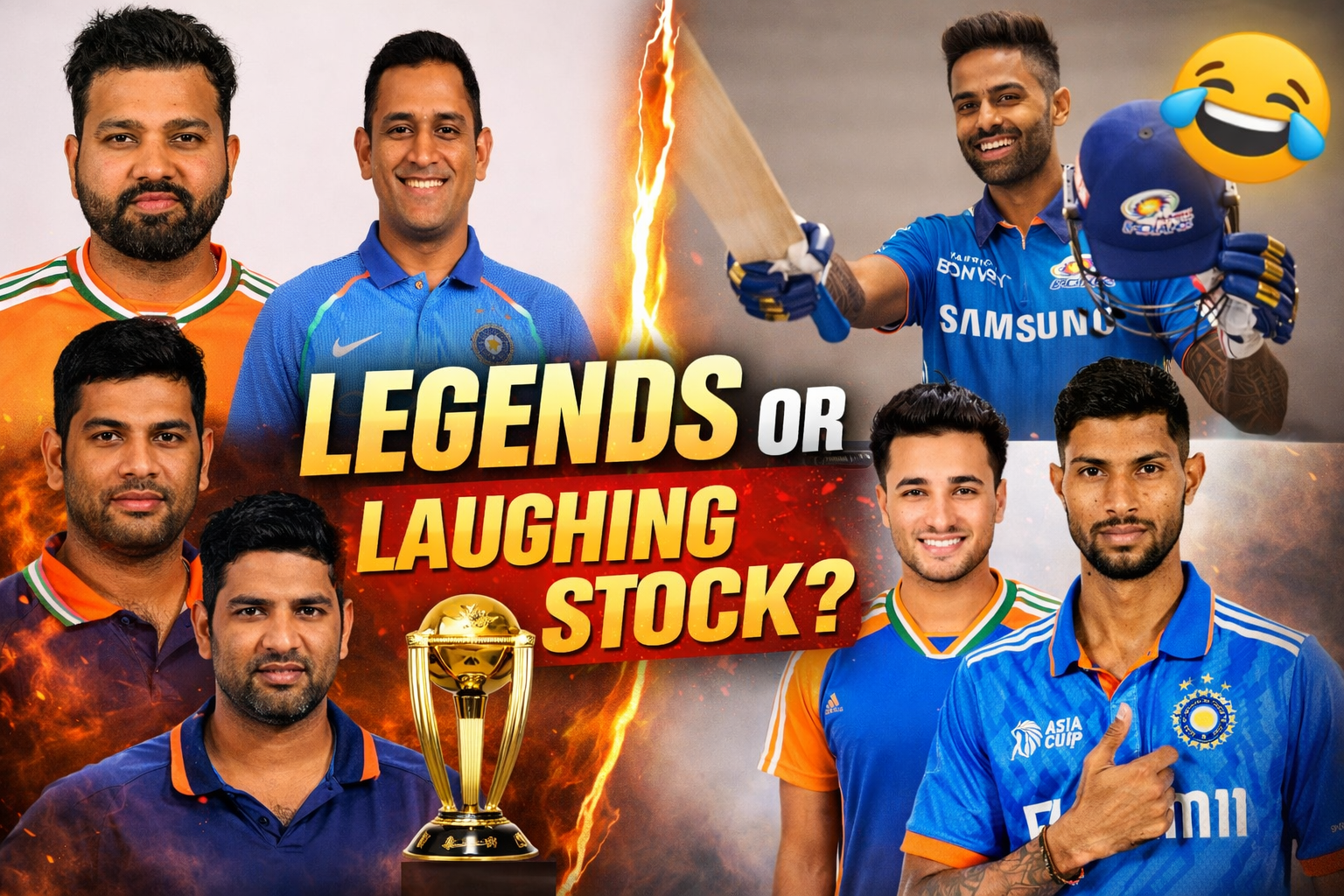
comparing Abhishek Sharma with Rohit Sharma. For many fans, this feels less like analysis and more like sacrilege. Rohit isn’t just a player; he’s a generational phenomenon who rewrote white-ball batting records. Expecting a young, inconsistent talent to mirror that legacy overnight is not only unrealistic — it’s unfair to both players. India’s problem isn’t Abhishek; it’s the desperation to manufacture the next Rohit before he’s even retired.
The same exaggeration appears when people casually place Tilak Varma in conversations with Yuvraj Singh. Yuvraj was a once-in-a-lifetime match-winner who thrived under World Cup pressure. Tilak may become a fine cricketer, but today the comparison feels like cricket comedy — not cricket journalism.
Then comes perhaps the boldest leap: linking Suryakumar Yadav with MS Dhoni. Dhoni defined calmness under chaos. Suryakumar defines improvisation and flair. Both are valuable, but they belong to completely different cricketing universes. Treating SKY as a Dhoni-like figure is like comparing fireworks to a nuclear reactor — exciting, but fundamentally different in impact and reliability.
The criticism doesn’t stop there. Names like Hardik Pandya, Shivam Dube, and Rinku Singh often divide fans. On their day, each can win matches. But inconsistency, fitness concerns, and role confusion continue to haunt the squad. India doesn’t lack talent — it lacks clarity, stability, and long-term planning. Selection experiments sometimes feel reactive rather than strategic, especially when chasing the glory of tournaments like the ICC Cricket World Cup.
Here’s the uncomfortable truth: India is not a weak team. But it is a team caught between eras — legends fading, replacements still maturing, and expectations refusing to wait. That gap creates frustration, sarcasm, and dramatic fan reactions — including jokes that even the India women's national cricket team might produce more entertaining cricket. While exaggerated, such comments reflect genuine anxiety about maintaining India’s dominance on the global stage.
Indian cricket audiences are among the most passionate in the world because they’ve witnessed greatness. That history becomes both a blessing and a curse — every new player is measured against giants before he has time to grow.
The real question isn’t whether India has talent. It’s whether management, selectors, and fans can allow this generation to evolve without suffocating it under impossible comparisons.
Because if history has taught us anything, it’s this: champions are built with patience — not nostalgia.